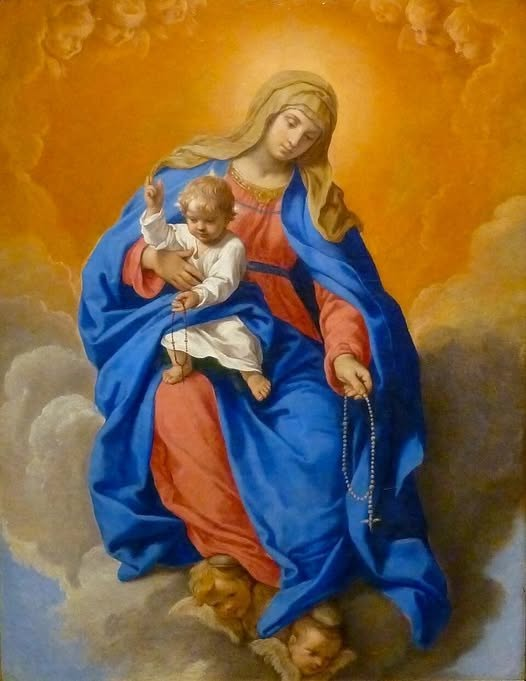
Our Lady of the Rosary
OUR LADY OF THE ROSARY. Feast Oct. 7
Our Lady of the Rosary (Latin: Beatae Mariae Virginis a Rosario), also known as Our Lady of the Holy Rosary, is a Marian title.
The Feast of Our Lady of the Rosary, formerly known as Feast of Our Lady of Victory and Feast of the Holy Rosary is celebrated on 7 October in the General Roman Calendar. 7 October is the anniversary of the decisive victory of the combined fleet of the Holy League of 1571 over the Ottoman Navy at the Battle of Lepanto.
In the Western Rite Vicariate of the Antiochian Orthodox Church, the feast is optionally celebrated on 7 October, under the title The Holy Rosary of the Blessed Virgin Mary.
Our Lady of the Rosary
According to Dominican tradition, in 1206, Dominic de Guzmán was at the Monastery of Our Lady of Prouille, in France, attempting to convert the Albigensians back to the Catholic faith. The young priest had little success until one day he received a vision of the Blessed Virgin, who gave him the Rosary as a tool against heretics.[2][3]
The story of Dominic's vision was recorded by Alanus de Rupe, a 15th-century Dominican friar who is credited with promoting the Rosary among the faithful in Europe.[4] This traditional origin for the Rosary was generally accepted, including by many popes,[5] until the 17th century, when the Bollandists concluded that the account originated with the account recorded by Alanus, two hundred years after Dominic's death.[6] However, several popes after the 17th century, like Pope Leo XIII[7][8] and Pope Pius XI,[9] continued to attribute its origin to Dominic in official documents such as encyclicals.[10]
Our Lady of Victory
Mary had been honored in the West under the title "Our Lady of Victory" from at least the thirteenth century. Simon de Montfort, 5th Earl of Leicester built the first shrine dedicated to Our Lady of Victory in thanks for the Catholic victory over the Albigensians at the Battle of Muret on September 12, 1213.[11] In thanksgiving for victory at the Battle of Bouvines in July 1214, Philip Augustus of France founded the Abbey of Notre Dame de la Victoire, between Senlis and Mont l'Evêque.[12]
In the East, the title "Our Lady of Victory" is even older. The feast of Our Lady of Victory, on February 25, commemorates the deliverance of the city of Constantinople "from the siege of the Saracens by the aid of the Blessed Virgin, A.D. 621."[13]
Feast day
Background
In 1571, Pope Pius V organized a coalition of forces from Spain and smaller Christian kingdoms, republics and military orders, to rescue Christian outposts in Cyprus, particularly the Venetian outpost at Famagusta which, however, surrendered after a long siege on 1 August before the Christian forces set sail. On 7 October 1571, the Holy League, a coalition of southern European Catholic maritime states, sailed from Messina, Sicily, and met a powerful Ottoman fleet in the Battle of Lepanto. Knowing that the Christian forces were at a distinct material disadvantage, Pope Pius V called for all of Europe to pray the Rosary for victory,[14][15][16] and led a rosary procession in Rome.[11] Pius V instituted the feast of Our Lady of Victory in order to commemorate the victory at Lepanto, which he attributed to the Blessed Virgin Mary.[11][4][17][3]
Victory of Lepanto
After about five hours of fighting on the northern edge of the Gulf of Corinth, off western Greece, the combined navies of the Papal States, Venice and Spain managed to stop the Ottoman navy, slowing the Ottoman advance to the west and denying them access to the Atlantic Ocean and the Americas.[18] If the Ottomans had won, there was a real possibility that an invasion of Italy could have followed so that the Ottoman sultan, already claiming to be emperor of the Romans, would have been in possession of both New and Old Rome.[19] Combined with the Great Siege of Malta (1565) and the unfolding events in Morocco where the Sa'adids successfully spurned the Ottoman advances, it confined Turkish naval power to the eastern Mediterranean. Although the Ottoman Empire was able to build more ships, it never fully recovered from the loss of trained sailors and marines, and was never again the Mediterranean naval power it had become the century before when Constantinople fell.[18]
In 1572, Pope Pius V formalized the number and content of the Mysteries of the Rosary and actively promoted its recitation.[4]
In 1573, Pope Gregory XIII changed the name of the feast into Feast of the Most Holy Rosary of the Bl. Virgin Mary, to be celebrated on the first Sunday of October.[20][3] The Dominican friar, Juan Lopez, in his 1584 book on the Rosary, states that the feast of the Rosary was offered "in memory and in perpetual gratitude of the miraculous victory that the Lord gave to his Christian people that day against the Turkish armada".[21]
In 1671, the observance of this festival was extended by Clement X to the whole of Spain, and somewhat later Clement XI, after the victory over the Turks gained by Prince Eugene in the Battle of Petrovaradin on 5 August 1716 (the feast of Our Lady of the Snows), commanded the feast of the Rosary to be celebrated by the universal church.[22][17]
Leo XIII raised the feast to the rank of a double of the second class and added to the Litany of Loreto the invocation "Queen of the Most Holy Rosary". On this feast, in every church in which the Rosary confraternity has been duly erected, a plenary indulgence toties quoties is granted upon certain conditions to all who visit therein the Rosary chapel or statue of Our Lady. This has been called the "Portiuncula" of the Rosary.[11][17] During his pontificate, Leo XIII issued eleven encyclicals about Our Lady of the Rosary and its feast.[23][24]
Pius X, in 1913, changed the date to 7 October, as part of his effort to restore celebration of the liturgy of the Sundays. In 1960, under Pope John XXIII, it is listed under the title Feast of the Blessed Virgin Mary of the Rosary; and under the 1969 liturgical reforms of Pope Paul VI, Our Lady of the Rosary is mentioned as a mandatory memorial.[25]
Our Lady of the Rosary is the patron saint of several places around the world. The Diocese of Malaga, Spain (which celebrates her patronage on September 8), and the Spanish cities of Melilla and Trujillo celebrate Our Lady of Victory as their patron.
Added translations that are not in the wikipedia English version:
The First Apparition
Seeing that the crimes of men were obstructing the conversion of the Albigensians, Saint Dominic entered a forest and spent three days and three nights in continuous prayer and penance. One day, the Blessed Virgin appeared to him accompanied by three princesses of heaven and said to him:
- Do you know, my dear Dominic, what weapon the Holy Trinity has used to reform the world?
- Oh, Lady — he replied — you know it better than I do, because, after your Son Jesus Christ, you were the main instrument of our salvation.
She added:
- Well, you know that the main part of the battle has been the Angelic Salutation, which is the foundation of the New Testament. So if you want to win those hardened hearts for God, pray my psalter.
The Virgin revealed:
- Only if people consider the life, death, and glory of my Son, united with the recitation of the Hail Mary, will the enemies be defeated. It is the most powerful way to destroy heresy, vices, to encourage virtue, to implore divine mercy, and to gain protection. The faithful will receive many blessings and will find in me someone always willing and ready to help them.
The Saint got up very consoled and filled with zeal for the good of these towns, entered the cathedral, and at that moment the bells rang (by the intervention of the angels) to gather the inhabitants. At the beginning of the preaching, a terrible storm arose, the earth shook, the sun was obscured, and the repeated thunder and lightning made the listeners shiver and turn pale. Their terror increased when they saw that an image of the Blessed Virgin, displayed in a prominent place, raised Her arms to the sky three times to ask God for vengeance against them if they did not convert and turn to the protection of the Holy Mother of God. Heaven intended with these prodigies to promote this new devotion of the Holy Rosary and make it better known. The storm finally ceased thanks to Saint Dominic's prayers. He continued his speech and explained with such fervor and enthusiasm the excellence of the Holy Rosary that almost all the inhabitants of Tolosa embraced it, renouncing to their mistakes, seeing in a short time, a big change in the life and customs of the city.
--
Promises of the Holy Rosary
When the devotion began to wane, the Virgin appeared to Alan de la Roche and told him to revive this Marian devotion. The Virgin also said that it would take immense volumes to record all the miracles achieved through the Holy Rosary and reiterated the promises given to Saint Dominic regarding the rosary.
--
Promises of Our Lady, Queen of the Holy Rosary, taken from the writings of Blessed Alan:
"To all who devoutly pray my Rosary, I promise my special protection."
"Whoever perseveres in praying my Rosary will receive very powerful graces."
"The Rosary is a powerful weapon against hell: it will destroy vices, free from sin, and crush heresies."
"The Rosary will make virtues and good works flourish again, and will obtain for souls God’s most abundant mercy."
"Whoever trusts in Me by praying the Rosary will not be overwhelmed by adversities."
"Whoever prays the Rosary while meditating on its mysteries will not be punished by God’s justice: they will repent if they are a sinner, grow in grace if they are righteous, and be made worthy of eternal life."
"Devotees of my Rosary, at the hour of death, will not die without the sacraments."
"Those who pray my Rosary will find, during life and at the hour of death, the light of God and the fullness of His graces, and will share in the merits of the blessed in heaven."
"Every day I will deliver from purgatory the souls devoted to my Rosary."
"The true children of my Rosary will enjoy great glory in heaven."
"Everything that is asked through the Rosary will be obtained."
"Those who spread my Rosary will be helped by Me in every one of their needs."
"I have obtained from my Son that all the devotees of the Rosary have as brothers in life and at the hour of death the saints of heaven."
“Those who faithfully recite my Rosary will all be my beloved children, brothers and sisters of Jesus.”
“Devotion to my Holy Rosary is a great sign of predestination.”
Many years later, in 1917, Our Lady of the Rosary appeared at Cova da Iria, in a town called Fátima, to three little shepherd children. The humble lady appeared many times, asking for prayer and atonement for sins to God and His Son Jesus. She made about 20 promises to those who would carry the rosary physically with much faith and devotion (wearing it around the neck, waist, or as a ring or bracelet).
1- To all who devoutly carry the Rosary, I will lead them to My Son.
2- To all who devoutly carry the Rosary, I will help them in their endeavors.
3- All who devoutly carry the Rosary will learn to love the Word, and the Word will make them free. They will no longer be slaves.
4- All who devoutly carry the Rosary will love My Son more and more.
5- All who devoutly carry the Rosary will have a deeper knowledge of My Son in their daily lives.
6- All who devoutly carry the Rosary will have a deep desire to dress decently so as not to lose the Virtue of modesty.
7- All who devoutly carry the Rosary will grow in the virtue of chastity.
The complete Rosary has 20 mysteries, which are the 5 mysteries of each day gathered one by one. This type of rosary is usually worn around the waist, or placed on statues dedicated to Mary of the Rosary.
8- Everyone who devoutly prays the Rosary will have a deeper awareness of their sins and will sincerely try to make amends in their lives.
9- Everyone who devoutly prays the Rosary will have a deep desire to spread the message of Fatima.
10- To everyone who devoutly prays the Rosary, I will pour out the graces of which I am the mediator.
11- Everyone who devoutly prays the Rosary will be filled with a deep desire to pray it and meditate on its mysteries.
12- Everyone who devoutly carries the Rosary will have peace in their daily lives.
13- Everyone who devoutly carries the Rosary will be comforted in times of sadness.
14- To everyone who devoutly carries the Rosary, the power to make wise decisions through the Holy Spirit will be granted.
15- To everyone who devoutly carries the Rosary, I will fill them with a deep desire to wear the Scapular of Mount Carmel.
16- Everyone who devoutly carries the Rosary will honor My Immaculate Heart and the sacred Heart of My Son Jesus.
17- Everyone who devoutly carries the Rosary will not take the name of God in vain.
18- Everyone who devoutly carries the Rosary will have deep compassion for the crucified Christ and will grow in their love for Him.
19- Many of those who devoutly carry the Rosary will be healed of physical, mental, and emotional illnesses; so take it to the sick and dying.
20- Families who devoutly carry the Rosary will have peace in their homes.
Traditions of the Patronal Feast of Our Lady of the Rosary:
Processions: Processions are a central part of the celebration, where the image of Our Lady of the Rosary is carried through the streets of the town or city. The faithful usually accompany the procession by praying the rosary and singing religious hymns.
Masses and religious services: Special masses are celebrated in honor of Our Lady of the Rosary during the feast. These masses may include sermons dedicated to the importance of the Virgin Mary in the Catholic faith and in the lives of the faithful.
Altar and chapel decoration: Many people decorate altars and chapels dedicated to the Virgin of the Rosary with flowers, candles, and other religious ornaments as part of the preparations for the festival.
Offerings and devotions: The faithful usually make offerings to the Virgin of the Rosary as a sign of devotion and gratitude for Her intercession. These offerings can include flowers, candles, written prayers, and other forms of expressing faith.
Social and cultural activities: Besides religious practices, the festival may include social and cultural activities, such as fairs, concerts, folk dances, and sporting events, which bring the community together in an atmosphere of joy and celebration.
Mantilla Decoration: On the eve of October 7th, mothers and their daughters get together to decorate mantillas with images of the Virgin of the Rosary, in honor of Her feast day. It's a tradition that is passed down from generation to generation, where devotion and art come together in an act of faith and filial love.
[and then the article quotes a lot of places in the world that have Our Lady of the Rosary as their Patroness]